This article was published in Peasants’ Voice, (Vol.1, No.2), the then organ of AIKKMS.
The Plight of Coconut Growers
In India, the coconut growers, particularly copra growers of the country, are in great distress with the massive fall of ball copra prices to Rs. 8,500, which was around Rs. 18,000 in the last season. The farmers are already suffering huge losses because of wet drought or dry drought, and an added crisis is the fall of prices for what they grow. In such a situation, the plight of coconut growers is no different. In fact, they are in a very helpless condition.
Coconut production supports the livelihood of millions of people. According to the Coconut Development Board, India is one of the largest coconut-producing countries in the world. It has contributed 22.34% to the world’s coconut production. As per the estimate made in July 2023, coconut will be cultivated in 19.10 lakh hectares and close to thirteen thousand million coconuts will be produced. Coconut contributes about Rs. 27,900 crore to India’s GDP, earning thousands of crores of foreign exchange. Around 90.77% of the total production of India is produced by the Kerala, Karnataka, Tamil Nadu, and Andhra Pradesh states.
Import and Export Policies
Coconut products are generally used in the preparation of food items and for industrial purposes like manufacturing soap, detergent, shampoo, synthetic rubber, and glycerine. It is also used in cosmetics, medical fields, and for other purposes. India exports coconut products as well as imports them. During 2021-22, India’s coconut exports crossed 3,236.83 crore rupees.
India is the largest coconut producer in the world. But paradoxically, the largest exporting countries are Indonesia, Thailand, Vietnam, and Sri Lanka. Tragically, India imports palm oil from Indonesia, Malaysia, and Thailand; soybean oil from Argentina, Brazil, Russia, and Ukraine; and coconut oil from Malaysia, Indonesia, Saudi Arabia, and Thailand.
Even though India is the largest producer of coconut, why are coconut products and edible oil imported? Because it is not just trade between the producer and the consumer, but trade managed by giant merchants—that is, giant corporates. They make a profit from both import and export. Before globalization, through tariff walls, imports and exports were under control so as not to disturb the regional market. Now that the tariff walls have broken down in the globalized world, products from other countries can easily enter the Indian market and push local farmers into destitution.
Imported coconut products and alternative products are available at very cheap prices because those exporting countries fall under free economic zones, which means zero tariffs, and they incur less cost of production. Small manufacturing units that used to use coconut oil earlier now use palm oil as an alternative. They use imported coconut powder which is very cheap. For profit-mongering capitalists, the price is more important than the quality. Manufacturers who used to use coconut products are now using cheap foreign products. So, the local market has collapsed. Local coconut products have lost demand, and prices have fallen.
Neglect of Coconut By-Products
By-products of coconut such as coconut fibre, shell, charcoal, water, pulp, and tree feathers are sources of sub-income for the farmers. They must be used in various ways to increase the income of the farmers. But without proper incentives, subsidies, and marketing facilities from the government, the demand for these by-products remains low. Even if the husk of a coconut is thrown on the street, there is no one to take it; no one asks for the shell, and so the income of the farmers has been hit further.
Injustice in Procurement
In buying coconuts through NAFED, farmers are being treated very unfairly. First of all, they do not buy the entire crop of the farmers; only 25 percent of the total crop of the country is purchased. The argument given by the government is that, first of all, there is no money, and secondly, it is unable to stock the produce. Not only that, in the name of quality, copra is rejected. Even after the purchase, money is not paid quickly.
The farmers cannot wait until payments are made by the government as their household expenses do not wait. Therefore, most of the time, the farmers are forced to sell to middlemen even if the price is very low. Consequently, the farmers cannot escape from the grip of middlemen and traders.
Consumption and Sale by Government Agencies
If the governments were concerned about the coconut farmers, they could have taken several measures to increase the demand for coconut products. Since coconut products are used for manufacturing soap and other items, if an order was issued to use coconut oil and other products compulsorily in government manufacturing units, the farmers could have escaped the impact of cheap imports. The government can buy coconuts and copra directly from the growers and sell them directly to consumers through the ration system and Janata Bazar. With this system, farmers benefit and consumers also get good quality coconuts and copra at a lower price than the market rate.
But instead, both the Central and State Governments are least concerned. Why are governments reluctant to take these measures? Governments are subservient to corporate companies. The common citizen is helpless under this democracy—the democracy of the haves. All the policies of the governments are encouraging corporate companies to enter agriculture and make enormous profits at the cost of poor peasants. Today, three Indians rank among the world’s richest people, but more than 50 percent of the people fall below the poverty line.
If the government takes the remedial measures suggested by us, the income of the middlemen and corporate companies will decrease because to make huge profits, they have to buy from the farmers at very low prices. Both import and export businesses earn a lot of profit when coconut products are processed and sold. The government takes away land from the farmers and gives all its help to companies for food processing units like Food Parks. But what is happening there? Did it help farmers? Even after Food Parks are established, neither the demand for agricultural produce nor employment has increased. It is a secret that no one knows. Governments do not reveal all this.
What is Our Way Forward?
We celebrated 75 years of independence of the country in 2023. But what delight do coconut farmers have in independent India? Coconut prices have fallen to an all-time low. Last year the price of coconut was Rs. 19,000; this year it has fallen to Rs. 7,000. Central and state governments are not supporting the coconut farmers and are stabbing them in the back.
The horticulture department of the government had recommended a minimum support price of Rs. 16,700 per quintal. The central government is sitting tight on that file. A scientific price for coconut has not been fixed. Farmers can neither sell to NAFED procurement centers nor in the private market. They are caught in the crosshairs, and coconuts are rotting at home.
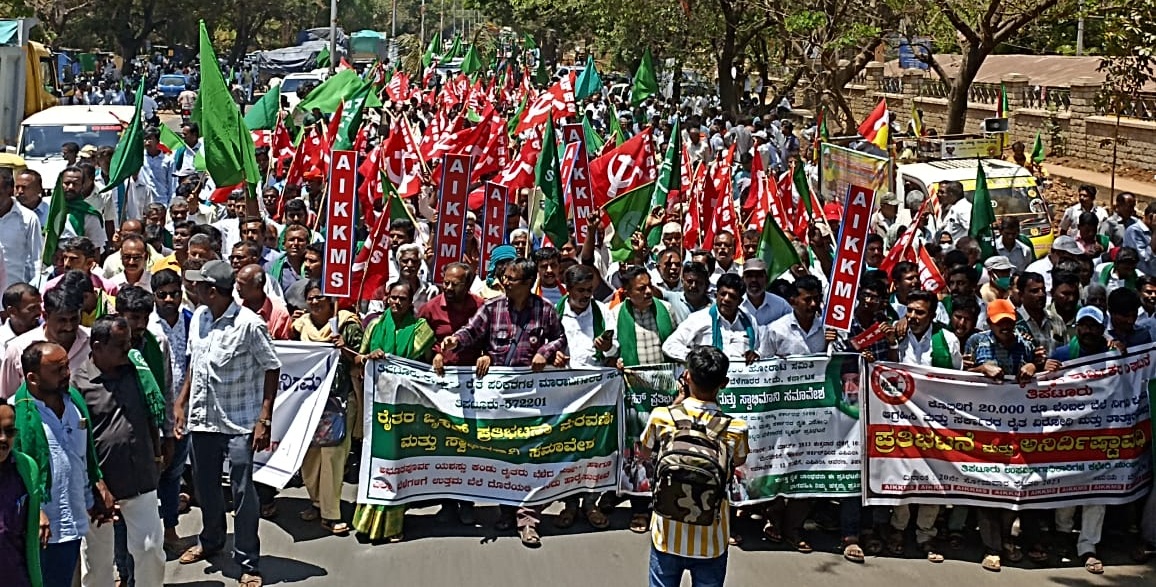
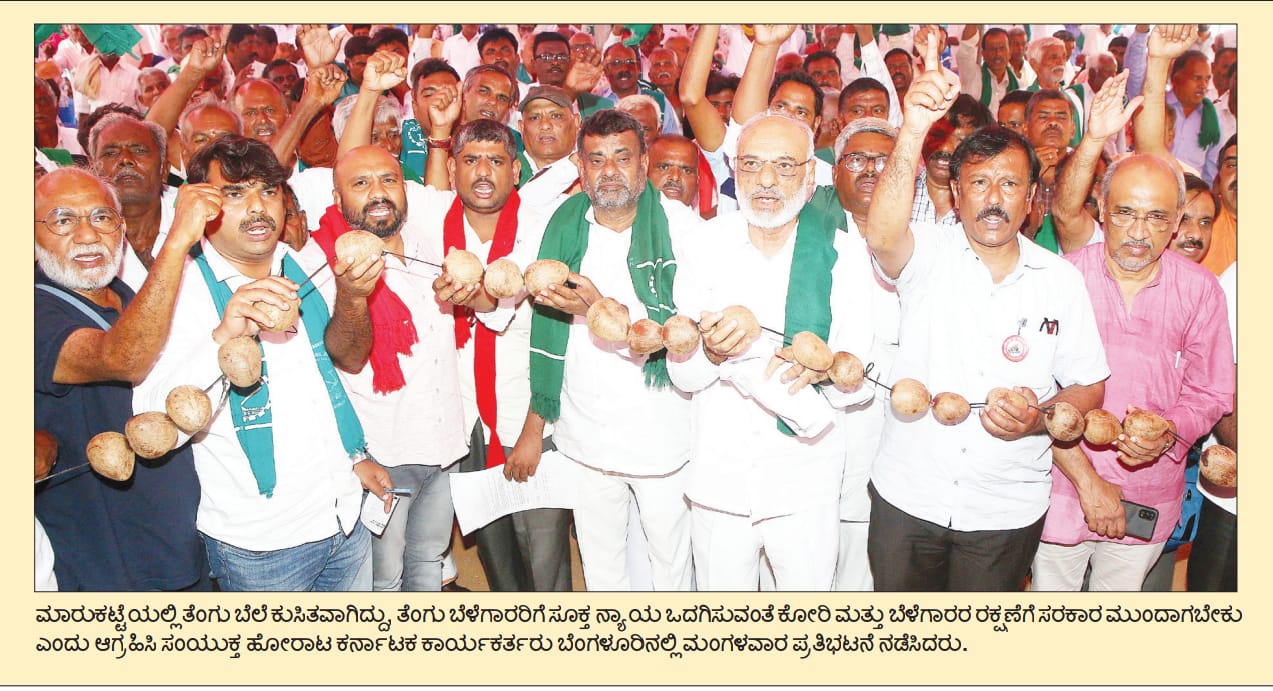
Coconut growers have staged protests and taken to the streets to put pressure on the government from all directions. In Karnataka, the state government has only announced an incentive of Rs. 1,250. The central government is not raising the minimum support price in a scientific manner. As the situation stands, the farmers have no option but to fight.
Today, the movements are happening in isolated places. A large-scale struggle is needed to warn the governments that have violated all their democratic commitments. For this, it is highly necessary that all those who are fighting for the coconut farmers should join the struggle.
In this direction, AIKKMS is consolidating coconut and copra growers throughout the country to address their plight and build up movements. It is developing a Coconut and Copra Growers Struggle Committee from the village level to the national level. It appeals to all coconut growers to come united and unleash a protracted struggle against pro-corporate, pro-capitalist governments and their henchmen.
Demands to the Central Government
- The Central Government should fix a Rs. 25,000 MSP per quintal for Copra.
- The entirety of coconut products should be purchased without restrictions, similar to procurement in North India, and this system must be legalized with the necessary finance released.
- Stop the immediate import of coconut products and edible oil in the open market or tariff-free zones.
- Manufacturing units under the Central Government that use oil must compulsorily use coconut oil.
- Massive Cold Storages to stock and keep products for a long time must be built so that they can accommodate the complete purchase of coconut products.
Demands to the State Government
- The State Government should provide an immediate incentive for Copra.
- Procurement centers must be opened at all Hobli levels, and the government should purchase under the MIS (Market Intervention Scheme).
- The government should encourage units that produce value-added items from coconut by-products and make the necessary arrangements to market them.
- Government manufacturing units must not use palm oil in place of coconut oil.
- The State Government must purchase copra and coconuts to distribute them through the PDS, Janata Bazaar, Anganwadi Centers, and student hostels.