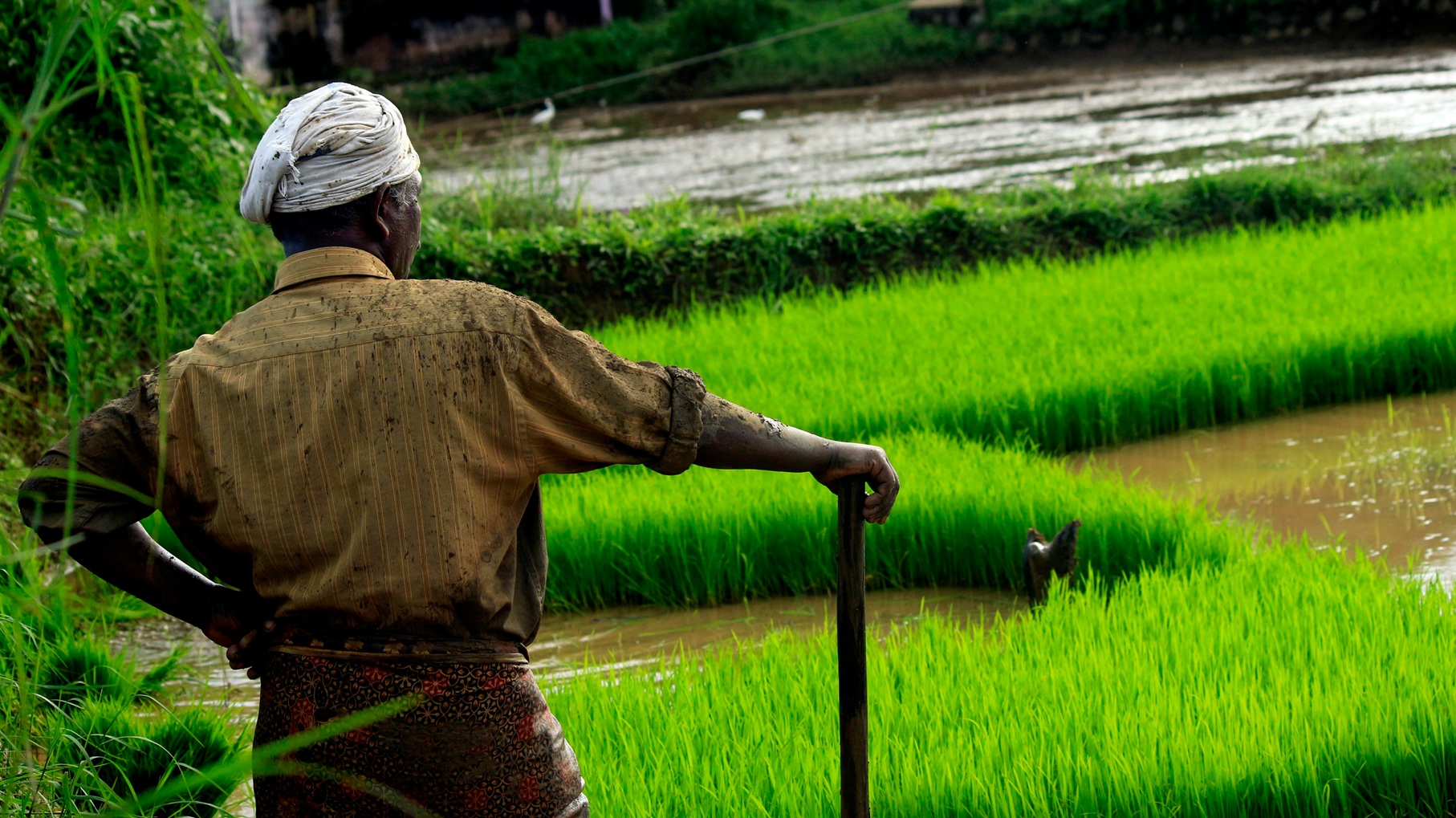
Paddy Farmers Movement in Kerala
An overview of the paddy farmers' movement in Kerala, the challenges faced by wetland and dryland farming, and the formation of NKSS.
This article was published in Peasants’ Voice, (Vol.1, No.2), the then organ of AIKKMS.
Paddy Cultivation in Kerala
Rice is the staple food of Kerala. Paddy is cultivated in 13 out of 14 districts. However, the area under paddy cultivation is dwindling year after year due to various reasons. Compared to that of the year 1975-76, the decrease is drastic. The total area under paddy cultivation at present is only 1,95,734.15 hectares.
Due to topographical conditions, dryland and wetland farming is prevalent in Kerala. Palakkad and the Kuttanad region of Alleppey (Alappuzha) district were once known as the granary of Kerala. Even now, these two are the leading districts predominant in paddy cultivation. The farming practices in these districts are distinctly different due to topographical differences.
As elsewhere in India, dryland farming is practiced in Palakkad and other highland districts, whereas in Kuttanad and other regions adjoining it, the practice is wetland farming. So, in addition to rainwater, the requirement of irrigated water is a must for the success of paddy farming in Palakkad and other highland districts. In the highland districts, especially in Palakkad, the farmers have to struggle additionally for getting sufficient and timely irrigated water to save the crop in the Rabi season.
In the case of low-lying lands, especially in the Kuttanad region, which lies below sea level and is intervened by saline backwaters, draining out water from the fields is a prerequisite for successful paddy cultivation. Every year, only after the recede of the monsoon floods are the farmers able to start farming activities in the Kharif season.
Procurement Crisis and Rising Unrest
The peculiarity of draining water by pumping as cited above, and the increased labour and other input costs, make the production cost of paddy very much higher than the national average. Under these circumstances, it is obvious that the farmers in Kerala require an MSP higher than the national average and increased interventions from the state and central governments to make paddy cultivation remunerative. Since Kerala is a deficit state in food production, the state government’s intervention has acquired paramount importance.
From 2022 onwards, the LDF government in Kerala delayed inordinately in evolving procurement policies. Even after the completion of the seasonal harvests, the government was lackadaisical in appointing the nodal agency for procurement and also in finding the financial agency for making payments. Due to this, the farmers’ anger and resentment rose high against the government.
Formation of NKSS (Nel Karshaka Samrakshana Samithi)
Sensing the mood of the paddy farmers, the AIKKMS State Committee organized a Protest Dharna in front of the Kuttanad Taluk Office of Alappuzha District. It was inaugurated by Com. N. Vinod Kumar, State Secretary of AIKKMS. Some leaders of other farmers’ organizations also participated in it as speakers. (They were the leaders who were earlier associated with the six-month-long solidarity programmes we had organized in Kuttanad while the Delhi Chalo movement was going on.)
This Dharna programme created much enthusiasm among the farmers of Kuttanad and paved the way for building a registered paddy farmers’ organization namely ‘Nel Karshaka Samrakshana Samithi’ (Save Paddy Farmers Committee), in short NKSS, in Kerala. Rajeena Ashraf of Kottayam District and Sonichan Pulinkunnu of Kuttanad are its president and secretary respectively. Com. Satheesan P.R., one of the Joint Secretaries of the AIKKMS State Committee, is its Working President. Comrades Ajaya Kumar A.G. and Mathew Thomas of the AIKKMS State Committee from Kottayam are its executive committee members.
Within a span of one and half years, NKSS could organize many local units and has spread over many areas of the Kuttanad region of Alappuzha district, Changanassery region of Kottayam, and the upper Kuttanad region of Pathanamthitta district. Simultaneously, NKSS organized many movements centering around delayed payments and other demands of the paddy growers during the last one and half years. Since its inception, it has rallied the farmers irrespective of any political affiliation in Kuttanad of Alappuzha district and adjoining regions of Kottayam district. A Secretariat March has also been organized, raising the demand for prompt payment for paddy. It has also represented movements in Palakkad district organized by some non-political peasant organizations of the district. Due to the impact of the movements, it acquired popularity in Kuttanad and now plays a pivotal role among farmers. The state government has done nothing to find a permanent solution to the problems faced by the paddy farmers. For the procurement of paddy and for prompt payment, budgetary provisions and a permanent mechanism are imperative.
The Procurement Mechanism and Its Flaws
The Kerala government used to entrust SupplyCo of the state as the nodal agency for procurement in the last two years. Funds have been raised as a loan from a Consortium of Banks as a stop-gap arrangement. The payments are made as a bank loan through the bank account of the farmer.
The first step is the online registration of the farmers willing to give their produce by the Department of Agriculture before the beginning of the harvest season. Thereafter, the government will negotiate with mill owners for the fixation of the ratio of paddy input and rice output for the purpose of handing over the rice for PDS distribution. After this process, the government will decide the nodal agency for procurement. Then the agricultural department will start procurement and issue Paddy Receipts (PRS) to the farmers. After completing this process, the farmers are required to submit the PRS to SupplyCo for processing. In turn, SupplyCo issues the payment advice to the respective banks preferred by the farmers. The banks will credit the amount into the farmers’ account as a loan received from the bank. For this, the farmers have to fulfill all the loan formalities of the bank. Failure of the loan repayment by the government will be treated as a default by the farmer, and the bank may initiate proceedings accordingly in the future.
Even now, one third of the farmers who have given their last year’s Rabi season paddy are waiting for payment. Such is the situation faced by the paddy farmers under the government ruled by the so-called LDF. The irresponsibility or inability of the government to raise sufficient funds for procurement is the prime reason for the delay in making payments. Similarly, parties like SupplyCo, banks, mill agents, etc., involved in these processes are also not friendly towards the farmers. All these factors and the spirit generated by the historic peasant movement of Delhi created a fighting spirit among the farmers.
NKSS Demands
- Create a Revolving Fund in the Budget for paddy procurement.
- Procure paddy at Rs. 3,264/quintal (MSP of Centre + State’s Production Incentive) immediately.
- Increase the paddy price based on the cost of production.
- The government should bear the handling charges completely.
- Stop the system of reduction in weight during the procurement of paddy.
- Revise the pumping subsidy and clear the dues of the production bonus.
- The Central Government must fix the MSP for Paddy at Rs. 3,500/quintal.