Rise Up to Fight Pro-Monopoly Anti-Peasant Agricultural Policies
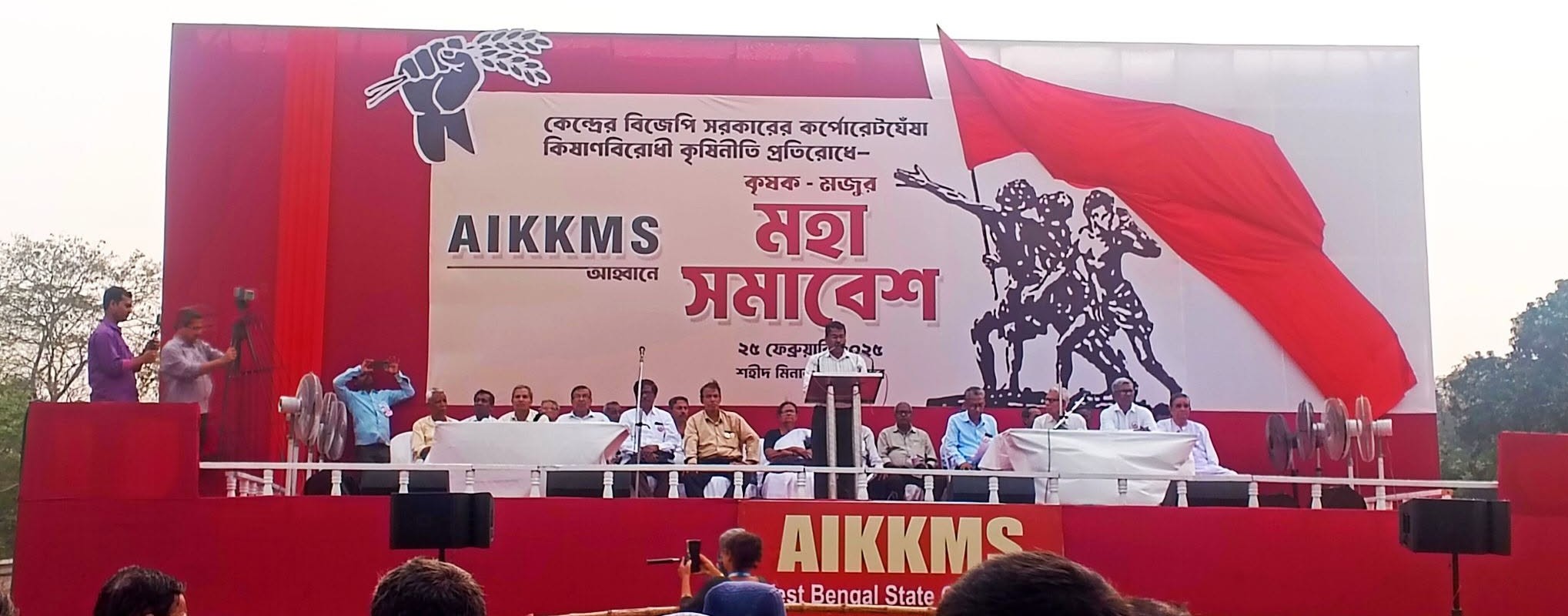
Sankar Ghosh's address to a massive gathering of peasants at Shaheed Maidan, Kolkata, fighting against the burning problems of peasants and agricultural labourers.
By Sankar Ghosh
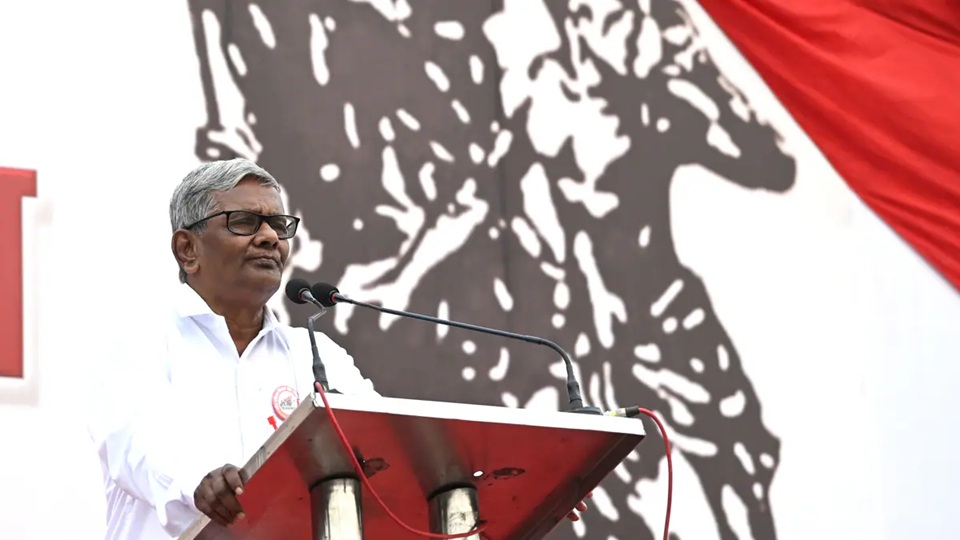
(Com. Shankar Ghosh, General Secretary of AIKKMS, addressed the massive gathering of peasants at Shaheed Maidan Grounds, Kolkata, West Bengal on February 25, 2025, organized by AIKKMS as a part of a nationwide protest against the burning problems of peasants and agricultural labourers.)
Nationwide Peasant Mobilization
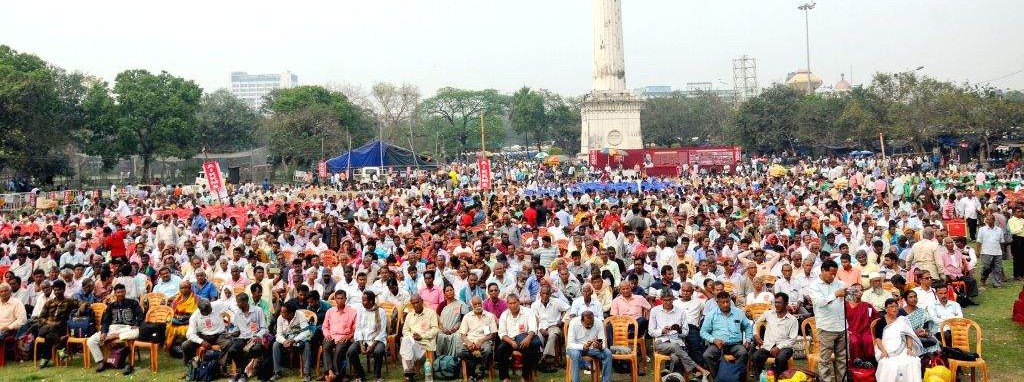
AIKKMS has organized peasant gatherings in 17 states today, February 25, 2025. As a part of this All India programme, the West Bengal state committee of AIKKMS has organized this mammoth gathering of peasants and agricultural workers here in Shahid Minar Maidan, Kolkata. Thousands of peasants and agricultural workers have assembled here from each and every district of the state.
In all these gatherings across India, the peasants and agricultural workers are expressing their woes and sufferings, and at the same time taking an oath to build up a mighty and sustained class struggle. So, it is clear we have not organized these assemblies just to express our pain and sorrow; it has far-reaching objectives.
In our lives, suffering is not a new thing. We are peasants; we are agricultural workers. Our lives are full of sorrows, and we are burdened with innumerable problems. We are losing our means of livelihood every day.
The Capitalist System and Historical Betrayal
Comrade Shibdas Ghosh, one of the foremost Marxist thinkers of this era and the founder of our organization, said long ago:
“Here in capitalism, it is the natural outcome of the system. Here you will lose your land and will be converted into agricultural labourers. Here you will be ousted from your sweet home to become a beggar. Here in this society, mothers, sisters, and daughters will lose their honour and dignity. You will work hard day and night, and the capitalists will reap its fruits. Debt burden will force you to commit suicide. Nothing except these could happen under this exploitative capitalist system.”
All this he said before our organization was even born. He said this on August 15, 1947, the day our country achieved independence. The whole country on that day was full of joy. On that day, in a meeting at Joynagar, West Bengal, he said:
“We are all happy to have independence. But in it, a bit of pain is there. To achieve independence, the common people of our country fought—Kshudiram sacrificed his life, Bagha Jatin, Pritilata, Ashfaq Ullah, and Bhagat Singh embraced martyrdom—but a handful of capitalists are reaping its fruits.”
Comrade Shibdas Ghosh was alone. Alone, he represented the real interest of the common people, the real interest of the workers and peasants. He said that till August 15, 1947, our task was to destroy British rule, but now a new task is on our shoulders, and that is to destroy the capitalist system and to establish a new system free from all sorts of exploitation of man by man.
Why must we fight against capitalism? Because capitalists are bloodsuckers. Because capitalism is anti-people, anti-peasant, and devoid of all sorts of moral values; because capitalism is the enemy of human civilization. It only knows profit and super-profit. Love, emotion, and other human values bear no meaning to capitalism. If you fail to destroy this capitalism, your future will be bleak. No future is there for your kith and kin. To fight against this heinous force of history, he founded our organization, AIKKMF (now AIKKMS).
When Comrade Shibdas Ghosh was trying to build up our organization, AIKKMS, the Bengal peasantry was in the midst of the historic Tebhaga Movement. The CPI leadership betrayed that movement. After a year’s struggle, they said:
“Peasants, go back to your homes, don’t engage yourselves in the Tebhaga Movement. Our ally, the Congress government led by Pandit Nehru, is now in power, so don’t disturb him. Leave the battlefield and go back to your sweet homes.”
Peasants were astonished to see the treacherous role of the CPI leadership. Frustration was looming large all over the state. But Comrade Shibdas Ghosh was not astonished to see this role of the CPI leadership. He knew their role in the Quit India Movement in 1942. Then, the CPI betrayed the Quit India Movement and helped British Imperialism. In the same manner, the CPI betrayed the Tebhaga Movement.
He made up his mind to organize the movement anew with a new spirit and goal. He was released from British jail in August 1945. He had a handful of followers and colleagues like Comrades Sachin Banerjee, Subodh Banerjee, Nihar Mukherjee, and Pritish Chanda. They took an oath:
“We will not allow this heroic peasant movement to go astray. The CPI betrayed the movement, so what? We will organize the sharecroppers in thousands and start the struggle again.”
They said:
“We have faith in the strength of the peasants. They will fight to the last and achieve their demands of Tebhaga (two-thirds of the agricultural produce for the sharecroppers and one-third for the owners of the land).”
The Roots of AIKKMS
So, Comrade Shibdas Ghosh started the struggle to organize the peasants of the Sundarban area of South 24 Parganas in West Bengal. We can easily imagine what a difficult task that was! He had to travel mile after mile on foot. To go to the villages in broad daylight was impossible due to the threats of the Jotedars. They had to move at night with an empty stomach. But nothing could deter their forward march.
With a painstaking struggle, at last, they were able to build up a powerful organization of peasants. As a result of their heroic struggle, the Tebhaga Movement in its second phase started in 1950, defying the suppression and oppression of the Jotedars, anti-social elements of the ruling Congress party, and the police. At last, the peasants achieved their victory.
It was a historic struggle of Comrade Shibdas Ghosh to organize the peasants of our country. He showed that a movement could achieve success if it is guided by correct revolutionary leadership. Through this struggle, he founded our organization, AIKKMS, in 1950. From then on, our organization went on fighting to hail the cause of the peasants and agricultural workers. In this noble struggle, hundreds of our workers and leaders embraced martyrdom.
Comrade Shibdas Ghosh showed that the peasants are not helpless, hapless people. They are full of energy and courage to fulfill their mission. They can build up a struggle under correct leadership to achieve their demands. So, he taught us to learn from the masses and act accordingly. He said:
“Go to the masses, live with them, learn from them, help them to build up their struggle committees, and then the time will come for their struggle for emancipation.”
The Alternative: All-Out State Trading
Comrade Shibdas Ghosh said that this capitalist system is responsible for all the problems of the peasants’ lives. So, peasants must engage themselves in the struggle to crush this exploitative capitalist state. So long as capitalism is there, the problems of peasants’ lives will be aggravated day by day. But it doesn’t mean, he said, that nothing could be done for the peasants and the common people under this capitalist system.
What could be done under this system? Comrade Shibdas Ghosh placed his planning before the country in 1950. It was a period of tremendous food crisis. The food crisis of 1948 continued up to 1950. Comrade Shibdas Ghosh explained the cause of this food crisis. Is it the natural outcome of the situation, he questioned. Is there really any shortage of food?
If there is a shortage of food, then buying food from the market would be difficult. But that is not the case. Anybody can purchase food and essential commodities as much as one wishes by paying an exorbitant price. Then actually, there is no shortage of food articles. Then why this crisis?
The problem is that food articles and essential commodities are in the hands of businessmen. They control it. They create an artificial crisis and sell food articles at an exorbitant price to make a super-profit. This is the crux of the problem.
Then what is the remedy? What action should be taken to end this crisis? Comrade Shibdas Ghosh said the remedy is easy and simple. It is not a complex one:
- The Government must oust the profiteers and businessmen from the sale and purchase of food articles and essential commodities and shoulder the responsibility to feed the people.
- For that, the Government must purchase 23 agricultural commodities directly from the peasants at the rate of C2+50% and sell them to the common people at a cheaper rate.
By this process, the peasants will get a remunerative price, agricultural workers will get jobs, millions of young people will get jobs, and the common people can purchase their food and essential commodities at a cheaper rate. It is termed as all-out state trading. It is the only way to save the peasants, agricultural workers, and the common people from hunger.
Pro-Monopoly Policies of the Centre and States
When we were in the midst of the struggle on the Delhi border against the three black farm acts, we met Mr. Amit Shah, the Home Minister of India. We placed the demand for MSP before him. He refused to introduce it due to a paucity of funds. But how much money is required to implement this planning? We showed with ample clarity that only 2 lakh crore rupees per year is required over the present expenditure to materialize this plan. Only two lakh crore rupees per year to save 135 crores of people in our country!
But the Government is not ready to spend this meager amount of money for the people. They can spend and are spending 15 lakh crore rupees for six multinationals, but not a single farthing for the common people. It is the attitude of the BJP-led Central Government.
The Trinamool-led State Government is doing the same thing in West Bengal. You know, jute is a very important commercial agricultural produce of West Bengal; 70 percent of jute is produced in this state. But what is the attitude of the State Government? The State Government is not purchasing a single kilogram of jute. We met with the agricultural marketing department of the State Government and appealed:
“Please, purchase jute directly from the peasants and sell it to the jute mill owners. Not a single farthing is required for that. It would help 5 lakh peasant families and innumerable agricultural workers of the state to survive.”
But we got no response from the State Government. The same is true for all the state governments of the country. All are apathetic to the problems of peasants and agricultural workers. It is because neither the Central Government nor the state governments are willing to go against the interests of the multinationals. They are the slaves of monopoly houses—slaves of Adani and Ambani.
Comrade Shibdas Ghosh taught us that these attacks on the people would grow much stronger day by day. Comrade Shibdas Ghosh was a great man, a great thinker, and a philosopher. His prophetic words have become true today. See what is happening nowadays.
Some days ago—on November 25, 2024—the Central BJP Government aired a new proposal in the country. What is that proposal? That is the Draft Policy for Agricultural Marketing Framework. They said: “We want to introduce such a system which is beneficial to the people.” What is that system? They say they want to introduce a marketing system on the basis of the PPP (Public-Private Partnership) model. What does that mean?
It means they want to hand over mandis and village haats, numbering 7,500 and 29,931 respectively, to different multinational companies. Why? Because according to their version, they are very efficient and that would help the peasants to prosper. Is it a reality? No, the reality is just the opposite.
If the multinationals are allowed to control the entire agricultural marketing system, then they will buy agricultural produce at a cheaper rate and sell those products at an exorbitant price to maximize profit. Now, the agricultural marketing system running in our country is also for the interest of the monopoly houses and the syndicates. It is true, but still, some room remains for small shopkeepers and peasants. In this new system, if it is implemented, they will be ousted. The peasants will not get a fair price for their produce on the one hand, and on the other, millions of small shopkeepers will be ousted from the market.
Adani and Ambani are not the people to give peasants a remunerative price. So, if this new marketing system is implemented, peasants will perish, agricultural workers will perish, small shopkeepers will perish, and the common people in general, who buy food articles from the market, will perish. This will be the consequence of the new policy.
The BJP Government wants to introduce this policy, but what is the role of the state governments? They have not uttered a single word against this policy. What is the meaning of it? They are in line with the BJP Government because their interests are the same. They all are serving the interests of their monopoly masters.
Capitalism, Fascism, and the Rise of Oppression
We know from the teachings of Comrade Shibdas Ghosh why the capitalist class is waging such a tremendous attack on the people. He showed that the capitalist class has no alternative. He showed that the capitalist class today is deeply crisis-ridden. Crisis is everywhere—crisis in economy, crisis in politics, crisis in culture. Its market is shrinking in comparison to its productive power. Practically, there is no new investment in the capital market; it is totally bankrupt. It is trying its best to survive, so it needs fascism.
Comrade Shibdas Ghosh is the only thinker today who showed clearly that whether it is advanced or backward, capitalism needs fascism. This is the order of the day. So, in our country, since independence, the ruling capitalist class has wanted to establish fascism. The then-ruling Congress government under the leadership of Pandit Nehru wanted to establish the rock-bottom foundation of fascism. His government strengthened the monopoly capital of our country. After Congress, the BJP Government took up the baton to strengthen fascist rule with giant strides.
What are they doing? They are spreading an anti-scientific, superstitious, and illogical bent of mind among the people, spreading communal and casteist mentality and hate politics throughout the country. It tries to convert the people into machines, devoid of all sorts of moral values. In our country, the BJP Government and all the pro-monopoly political parties are jointly doing this thing.
This fascism is a dangerous thing—a dangerous enemy of mankind. Comrade Shibdas Ghosh warned the workers and peasants of our country, saying:
“If fascism is once established, then there will be no man in this country, because it destroys the very process of creating human values.”
We, the peasants and workers, must bear in mind this invaluable teaching of Comrade Shibdas Ghosh and act accordingly.
Again, don’t think that they are waging attacks only on the peasants and agricultural workers. They are waging tremendous attacks on the workers also. Hard-earned rights of the working class are trampled underfoot. They are attacking the students, youth, and women as well. So, all sections of the toiling people are being constantly attacked by these multinationals.
Our enemy is one—multinationals at home and abroad. We are to build up a struggle unitedly against this enemy of the oppressed people.
The Revolutionary Heritage of the Peasantry
The peasants have a special role in this noble struggle. In the future, the Indian revolution will take place under the leadership of the proletariat class—that is obvious. But in this noble cause, the responsibility of the peasants and agricultural workers is great. In this vast land, seventy percent of the people are directly or indirectly linked to agriculture. They are to perform their role as an ally of the revolution. In this sense, the responsibility of AIKKMS is great.
The question is: are the peasants and agricultural workers able to perform this historic responsibility? We think they are capable enough; it is the teaching of history. Some say the peasants are ignorant and illiterate, that they are poor and full of superstition, so how would they be able to overthrow this mighty capitalist state power? This type of thinking is nothing but a sign of ignorance regarding the power and strength of the peasants and agricultural workers.
Comrades, remember the great struggles of the past. Who fought against the British rulers? When there was no nationalism, when the minds of the people were not filled with the emotion of “this land is my mother,” when Kshudiram, Bagha Jatin, Ashfaq Ullah, Bhagat Singh, and Pritilata had not yet embraced death as a friend—who fought against the British rulers then? It was the illiterate peasant who fought and embraced death in thousands, and that is the noble heritage of our country.
Comrades, remember the historic Sanyasi-Fakir Rebellion of Bengal in 1763, which lasted for 38 years and defeated British troops in many battles. Remember the Munda Rebellion, the Santhal Rebellion, and the Indigo Rebellion of Bengal. After that, the Pagri Sambhal Movement of Punjab peasants in 1907 under the leadership of Sardar Ajit Singh, uncle of Shaheed-e-Azam Bhagat Singh. Then the struggle of the peasants under the leadership of Alluri Sitarama Raju in Andhra, the Tebhaga Movement in Bengal, and the Telangana Movement in Andhra Pradesh—all these movements were organized and fought by the peasants and peasants alone.
After that, in the period of globalization, we saw the great battle of the peasants of Singur and Nandigram in Bengal. This heroic struggle of Singur and Nandigram opened the eyes of the toiling millions. Is it not a glorious history to be reckoned with? The rulers of the then West Bengal with much vanity said, “We will crush the heads of the peasants if they dare to oppose us.” What happened? The peasants, taking direct assistance from other sections of the toiling masses, threw those tyrants away from governmental power. So, peasants can do it—no doubt about it.
Lessons from the Delhi Movement & Future Tasks
Again, we saw the undaunted courage and heroism of the peasants in the Delhi Movement. Modiji declared there was no question of repealing the enacted three farm acts. Peasants said: “We will bow your head; we will force you to repeal those black farm acts.” Peasants raised the slogan: “We shall fight, we will win.”
Friends, this struggle was not a struggle for one day. It continued up to thirteen months, facing tremendous cold and scorching heat. Peasants embraced death one by one; we saw it with our own eyes. 736 peasants embraced martyrdom. It is unparalleled in the history of the democratic movement. Here in this struggle, we, the peasants, defeated the combined power of the multinationals and their henchmen.
Peasants realized from the experience of their struggle that the Central BJP Government is only a mask of the capitalist class—the Adanis and Ambanis. This capitalist class is the root cause of their problems, and they have to face it. In this way, peasants learnt from their experience who their friends are and who their enemies are, and in what way they are to fight against the enemies, with what type of organization, and under what type of leadership. This is the teaching of history, and here AIKKMS must play its historic role because AIKKMS is armed with the scientific ideology of Comrade Shibdas Ghosh. So, to lead the peasants’ struggle to its ultimate goal is its historic responsibility.
How can AIKKMS perform this historic responsibility? At the present moment, we cannot perform this historic responsibility alone. We are to build up a mighty struggle unitedly with other peasant organizations, and that united platform is already there in our country. Through the 13-month-long struggle on the Delhi border, we built up this platform of different peasant organizations—Samyukta Kisan Morcha (SKM). Our organization, AIKKMS, is an important constituent of that platform, and we try our best to perform our historic responsibility.
We placed our views on different issues on the basis of the teachings of Comrade Shibdas Ghosh. Similarly, we placed our detailed planning in the last meeting of SKM to fight against the notorious draft on the Agricultural Marketing Framework. In that plan, we said:
- We are to recruit volunteers of the movement from the peasants and agricultural workers from at least 3 lakh villages.
- At the same time, we are to build up village committees there and organize big mass meetings like this to organize the peasants for the ensuing mass struggle.
Taking such preparations, we are to spread the movement across the country—millions and millions of people will assemble for an indefinite dharna in the state capitals of different states.
We must keep one thing in mind. Side by side with our efforts, the workers of our country will make preparations along with the students, youth, and women. Unitedly, we shall fight to uproot the exploiters. This is our mission, and this is our goal.
Call to Action
Here, I would like to remind you of an invaluable teaching of Comrade Shibdas Ghosh on the responsibility of the laboring peasants to bring about social change. He said:
“Remember, this struggle is a great battle. It is no battle of a mercenary army. It is a revolution, staking everything to save the country from deep distress, to free industry, agriculture, rural life, the decadent urban life, the cultural life of the nation, even science and technical education from the shackles of capitalist oppression, from its vicious cycle of looting profits. Today, that great onus of revolution devolves upon the workers and the peasants. Remember, the babus will not achieve this revolution for you. A handful of them may come to you, imbued with the revolutionary ideology, abjuring their class interest, and at most try to arouse you to take on the leadership of the revolution. But this revolution will materialize successfully only that day when revolutionary cadres and leaders in large numbers rise from the families of workers and peasants. Till then, you will stride on with dreams in your eyes for the revolution. Till then, revolution will not come forth; it will remain a distant cry.” (Works, Vol. 3, Pages 260-61)
Comrades, note his words. Until and unless we can recruit thousands and thousands of volunteers from peasant families, our revolution will remain a distant cry. It means he believed that thousands and thousands of volunteers can be recruited from the peasants and they, under the leadership of the proletariat, will accomplish the task of revolution. He created AIKKMS to fulfill this historic task. We must do it with revolutionary audacity and courage.
Inquilab Zindabad!
AIKKMS Zindabad!
Red Salute to Comrade Shibdas Ghosh!